
Close Menu
    Facebook X (Twitter) Instagram
    SciTechDaily
    • Biology
    • Chemistry
    • Earth
    • Health
    • Physics
    • Science
    • Space
    • Technology
    Facebook X (Twitter) Pinterest YouTube RSS
    SciTechDaily
    Home»Health»Korean Scientists Develop Novel “Bone Bandage” Material for Cracked Bones
    Health

    Korean Scientists Develop Novel “Bone Bandage” Material for Cracked Bones

    By The Korea Advanced Institute of Science and Technology (KAIST)February 17, 2024No Comments4 Mins Read
    Facebook Twitter Pinterest Telegram LinkedIn WhatsApp Email Reddit
    Share
    Facebook Twitter LinkedIn Pinterest Telegram Email Reddit
    Magnifying Glass Bone Hip
    A groundbreaking development in bone regeneration has been achieved with the creation of a piezoelectric scaffold by a KAIST-led research team. Utilizing hydroxyapatite (HAp) to generate electrical signals under pressure, this scaffold mimics the natural environment of bone tissue, showing promising results in promoting bone growth through both laboratory and animal studies. This advancement opens new pathways for biomaterial design and the understanding of bone regeneration processes.

    Bone regeneration is a complicated procedure, and the current approaches for facilitating this regeneration, such as grafts and the application of growth factors, encounter challenges like elevated expenses. However, a breakthrough has been made with the creation of a piezoelectric material that has the capability to enhance bone tissue development.

    A KAIST research team led by Professor Seungbum Hong from the Department of Materials Science and Engineering (DMSE) announced on January 25 the development of a biomimetic scaffold that generates electrical signals upon the application of pressure by utilizing the unique osteogenic ability of hydroxyapatite (HAp). This research was conducted in collaboration with a team led by Professor Jangho Kim from the Department of Convergence Biosystems Engineering at Chonnam National University.

    HAp is a basic calcium phosphate material found in bones and teeth. This biocompatible mineral substance is also known to prevent tooth decay and is often used in toothpaste.

    Breakthrough in Bone Regeneration

    Previous studies on piezoelectric scaffolds confirmed the effects of piezoelectricity on promoting bone regeneration and improving bone fusion in various polymer-based materials, but were limited in simulating the complex cellular environment required for optimal bone tissue regeneration. However, this research suggests a new method for utilizing the unique osteogenic abilities of HAp to develop a material that mimics the environment for bone tissue in a living body.
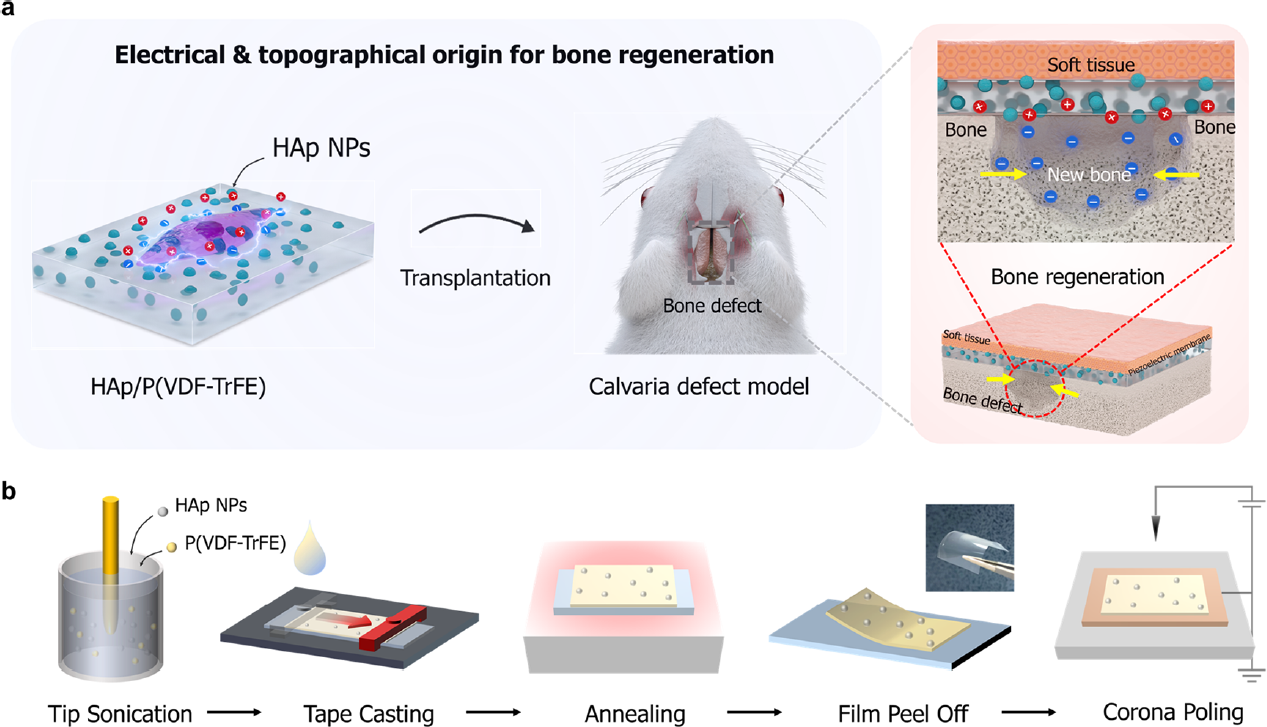
    Design and Characterization of Piezoelectrically and Topographically Originated Biomimetic Scaffolds
    Figure 1. Design and characterization of piezoelectrically and topographically originated biomimetic scaffolds. (a) Schematic representation of the enhanced bone regeneration mechanism through electrical and topographical cues provided by HAp-incorporated P(VDF-TrFE) scaffolds. (b) Schematic diagram of the fabrication process. Credit: KAIST Materials Imaging and Integration Laboratory

    The research team developed a manufacturing process that fuses HAp with a polymer film. The flexible and free-standing scaffold developed through this process demonstrated its remarkable potential for promoting bone regeneration through in-vitro and in-vivo experiments in rats.

    Understanding the Principles of Bone Regeneration

    The team also identified the principles of bone regeneration that their scaffold is based on. Using atomic force microscopy (AFM), they analyzed the electrical properties of the scaffold and evaluated the detailed surface properties related to cell shape and cell skeletal protein formation. They also investigated the effects of piezoelectricity and surface properties on the expression of growth factors.

    Design and Characterization of Piezoelectrically and Topographically Originated Biomimetic Scaffolds
    Figure 1. Design and characterization of piezoelectrically and topographically originated biomimetic scaffolds. (a) Schematic representation of the enhanced bone regeneration mechanism through electrical and topographical cues provided by HAp-incorporated P(VDF-TrFE) scaffolds. (b) Schematic diagram of the fabrication process. Credit: KAIST Materials Imaging and Integration Laboratory

    Professor Hong from KAIST’s DMSE said, “We have developed a HAp-based piezoelectric composite material that can act like a ‘bone bandage’ through its ability to accelerate bone regeneration.” He added, “This research not only suggests a new direction for designing biomaterials, but is also significant in having explored the effects of piezoelectricity and surface properties on bone regeneration.”

    Reference: “Piezoelectrically and Topographically Engineered Scaffolds for Accelerating Bone Regeneration” by Soyun Joo, Yonghyun Gwon, Soyeon Kim, Sunho Park, Jangho Kim and Seungbum Hong, 4 January 2024, ACS Applied Materials & Interfaces.
    DOI: 10.1021/acsami.3c12575

    This research was supported by the KAIST Research and Development Team, the KUSTAR-KAIST Joint Research Center, the KAIST Global Singularity Project, and the government-funded Basic Research Project by the National Research Foundation of Korea.

    Never miss a breakthrough: Join the SciTechDaily newsletter.
    Follow us on Google and Google News.

    Bones Korea Advanced Institute of Science and Technology Regeneration
    Share. Facebook Twitter Pinterest LinkedIn Email Reddit

    Related Articles

    Blood Becomes Medicine in a Revolutionary Regeneration Breakthrough

    A Surprising Superfood: Scientists Discover New Health Benefits of Prunes

    Long-Standing Puzzle Solved: Scientists Discover a New Hormone That Can Double Bone Mass

    Bone Medications Transform Into Fungal Fighters in Groundbreaking Study

    Bone Cancer Breakthrough: UCL’s New T-Cell Therapy Shows Promise

    Could Getting Enough Sleep Help Prevent Osteoporosis?

    Startling Findings – Entirely New COVID-Related Syndrome Discovered

    A Simple Pinch May Predict Spinal Fractures: Arm Fat’s Surprising Role in Bone Quality and Strength

    Unlocking the Mystery: News Clues About the Cause of Common Birth Defects

    Leave A Reply Cancel Reply

    • Facebook
    • Twitter
    • Pinterest
    • YouTube

    Don't Miss a Discovery

    Subscribe for the Latest in Science & Tech!

    Trending News

    One of the Universe’s Largest Stars May Be Getting Ready To Explode

    Scientists Discover Enzyme That Could Supercharge Ozempic-Like Weight Loss Drugs

    Popular Sweetener Linked to DNA Damage – “It’s Something You Should Not Be Eating”

    Ancient “Rock” Microbes May Reveal How Complex Life Began

    Researchers Capture Quantum Interference in One of Nature’s Rarest Atoms

    “A Plague Is Upon Us”: The Mass Death That Changed an Ancient City Forever

    Scientists Discover Game-Changing New Way To Treat High Cholesterol

    This Small Change to Your Exercise Routine Could Be the Secret to Living Longer

    Follow SciTechDaily
    • Facebook
    • Twitter
    • YouTube
    • Pinterest
    • Newsletter
    • RSS
    SciTech News
    • Biology News
    • Chemistry News
    • Earth News
    • Health News
    • Physics News
    • Science News
    • Space News
    • Technology News
    Recent Posts
    • Scientists Rethink Extreme Warming After Surprising Ocean Discovery
    • The Surprising Role of Asteroids in the Origin of Life
    • Scientists Raise Concerns Over Newly Recognized Pollutant Found Everywhere in the Air
    • New Study Challenges 40-Year Puzzle About Childhood Body Fat
    • 20-Year Study Finds Daily Multivitamins Don’t Extend Lifespan
    Copyright © 1998 - 2026 SciTechDaily. All Rights Reserved.
    • Science News
    • About
    • Contact
    • Editorial Board
    • Privacy Policy
    • Terms of Use

    Type above and press Enter to search. Press Esc to cancel.